GHK-Cu benefits, what the evidence supports
By The PepVise Editorial Team · Reviewed June 30, 2026 · 10 min read
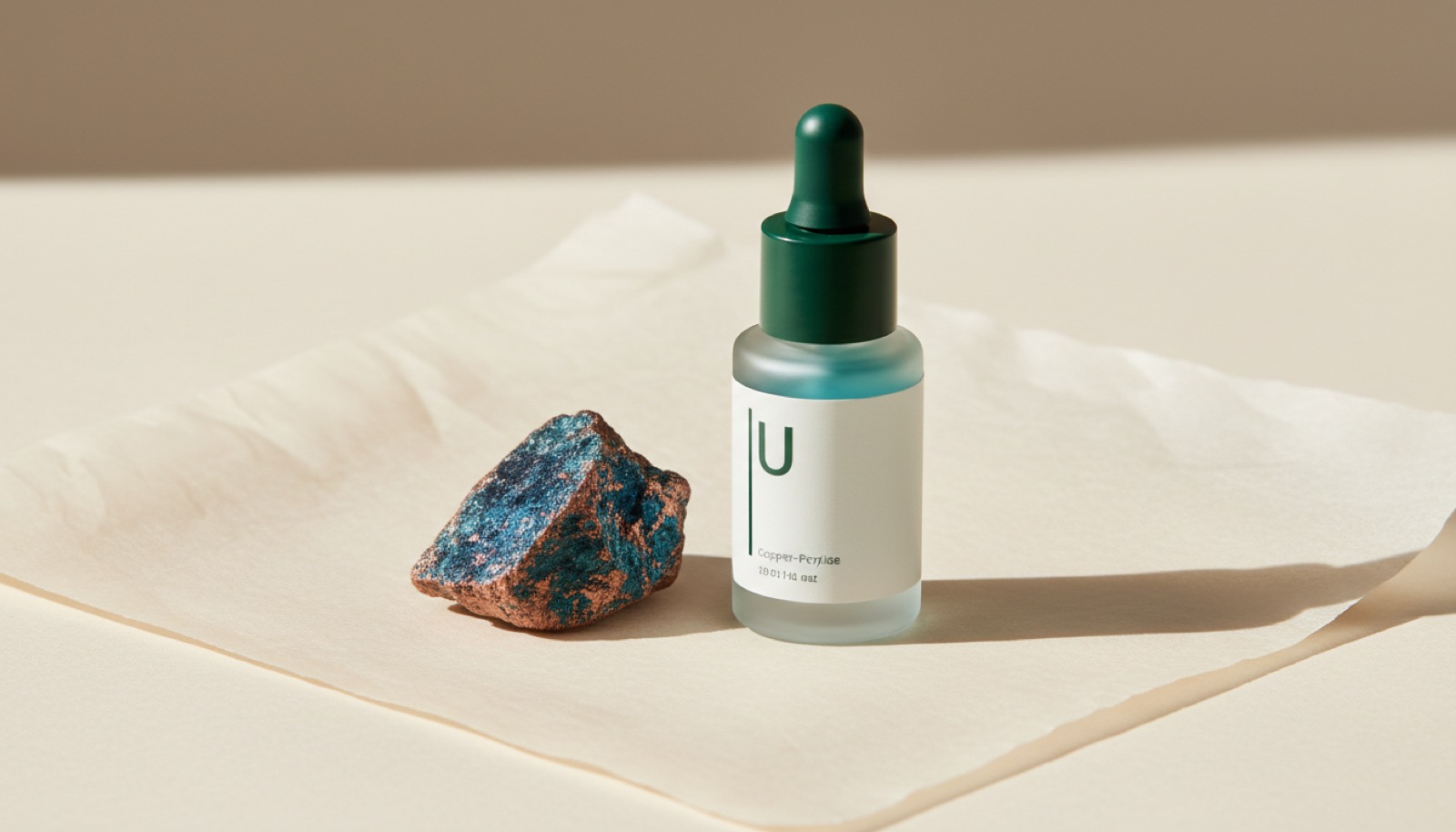
Which GHK-Cu benefits are backed by randomized human data and which are extrapolated from cell and animal work: strong topical skin and hair signals, weak injectable data, and why that split is the whole story.
Mechanism explainers on PepVise aim for textbook-level clarity without the textbook's refusal to commit to a reading.
What readers ask us next.
- What are the best-supported benefits of GHK-Cu?
- The best-supported benefits are topical cosmetic skin effects. Small randomized and controlled studies of topical GHK-Cu formulations report improved skin firmness, reduced fine lines, and better skin density. This evidence concerns creams and serums applied to the skin, not injectable preparations.
- Does GHK-Cu help with hair loss?
- The hair evidence is weaker than the skin evidence but not zero. Copper peptides are linked in some small studies and formulations to an improved follicular environment and hair density, usually topically and often in combination products, which makes attributing the effect to GHK-Cu alone difficult. It is a plausible but less firmly established use than skincare.
- Are the injectable GHK-Cu benefits proven?
- No, not in humans. The systemic benefits marketed for wound healing, tissue regeneration, and anti-aging rest largely on cell-culture and animal studies. Controlled human trials of injectable GHK-Cu are absent. The robust human data concern topical use; everything else is extrapolation.
- Why does GHK-Cu work topically but lack injectable evidence?
- The randomized human data that exist were generated on topical cosmetic formulations, because that is how GHK-Cu has mainly been studied and sold for skin. Injectable use has not been put through equivalent controlled human trials, so its benefits remain at the cell and animal stage rather than the proven-human stage.
- Why does PepVise not recommend a GHK-Cu product or dose?
- Because we do not recommend specific products or doses and we do not affiliate-link to peptide vendors. We describe which benefits the evidence supports and at what tier, and leave any use decision to the reader and a licensed physician. The full evidence state is in our GHK-Cu profile.
References cited on this page.
PubMed, ClinicalTrials.gov, and FDA documents only. Secondary sources appear when needed to characterize public discourse, never as a source for a clinical claim.
- [01]Pickart L, Margolina A. Regenerative and protective actions of the GHK-Cu peptide: review indexing the skin and hair literature. Int J Mol Sci 2018;19(7):1987 (open access; read critically, Pickart described the molecule)
- [02]Pickart L, Vasquez-Soltero JM, Margolina A. GHK peptide as a natural modulator of multiple cellular pathways in skin regeneration. Biomed Res Int 2015;2015:648108
- [03]Badenhorst T, Svirskis D, Wu Z. Physicochemical characterization and stability of the copper-binding tripeptide GHK-Cu (preclinical and formulation context). Pharm Dev Technol 2016
- [04]ClinicalTrials.gov, 'GHK-Cu' and 'copper tripeptide' listings
About The Pepvise Editorial Team
The Pepvise Editorial Team is a small group of researchers and science writers reading the peer-reviewed peptide literature and translating it into calm, cited analysis. We do not sell peptides, recommend peptides, or tell readers what to administer. We describe what has been measured, by whom, at what scale, with what effect size.
Compound reviews are signed off by Dr. Priya Narang, MD, MPH (endocrinologist) and Dr. Marcus Haley, PharmD, BCPS (board-certified clinical pharmacist). Both hold verifiable state-board licenses and have signed editorial-independence letters with us. See the full editorial board →
Adjacent in the literature.
BPC-157, What the Evidence Shows
Evidence Ledger for BPC-157: 50+ preclinical studies, 1 human pilot (Chang 2014, n=12), 1 active Phase trial, FDA removed from 503A list in 2023.
16 min readCompounds · Compound profileTB-500, The Field Guide
TB-500 vs Thymosin Beta-4 (same compound), mechanism, the preclinical tendon and recovery literature, and where the human data is thin.
14 min readCompounds · Compound profileGHK-Cu, Evidence and Hype
Copper peptide signaling, the topical RCT evidence for hair and skin, and the gap between topical and injectable claims.
13 min readGet the 2026 Peptide Evidence Ledger.
A 12-page PDF summary of where 10 major compounds sit, Preclinical / Human pilot / Phase trial / FDA status. Updated quarterly. Free.
By subscribing, you agree to our Privacy Policy. One calm, cited email a week. Unsubscribe anytime.