Analysis
Upgrade pick for skin and dermal applications. Topical cosmetic formulations are available legitimately, which sidesteps most of the vendor-trust problem.
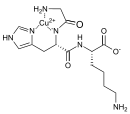
GHK-Cu is the highest-scoring entry in the database and the upgrade pick when budget is not the constraint and the use case is dermal. Forty-plus human studies (cosmetic short-trial work, topical wound healing, hair density) sit behind a mechanism that is properly published, copper transport into the cell with downstream collagen and elastin upregulation. Crucially, GHK-Cu can be sourced as a topical cosmetic formulation through ordinary retail channels, which collapses the vendor-trust risk that pulls BPC-157 and TB-500 down by a full point each. The score gap between #1 and #3 is real, and we want readers to see it: GHK-Cu earns 8.1 because it has both the evidence and the legal supply chain. BPC-157 leads the category by name recognition, not by score.
Top four on every dimension.
Higher is better. Numbers are tabular, the methodology is on the methodology page, and yes, vendor trust counts because counterfeit risk is real.
Pros and cons
| WHAT WORKS | WHAT DOES NOT |
|---|---|
| Forty-plus published human studies including double-blind cosmetic trials. | Most human work is topical and short follow-up. |
| Established mechanism, copper transport plus collagen and elastin upregulation. | Injectable GHK-Cu protocols are still in research-use territory. |
| Available in legitimate cosmetic formulations, which removes the vendor-counterfeit risk that drags BPC-157 and TB-500 down. | , |
| WADA does not list GHK-Cu, regulatory pathway is clean. | , |
Alternatives we tested
Three compounds that came up in the same comparison set.
- #1 · LEAD REVIEW6.8BPC-157Body Protection Compound 157
The most-studied research peptide in rodents. Human evidence remains thin and the FDA narrowed its compounding pathway in 2023.
- #2 · MOST REQUESTED5.9TB-500Thymosin Beta-4 fragment
The actin-binding biology is real; what most online sources sell as TB-500 is a fragment, not the full thymosin beta-4 protein.
References
4 cited- Pickart et al. 2012, GHK-Cu wound and dermal review, Biomed Res Int
- Pickart & Margolina 2018, GHK-Cu in skin remodelling, Cosmetics
- Trumbore et al. 2018, GHK-Cu hair regrowth, J Cosmet Dermatol
- Park et al. 2016, GHK-Cu mechanism in collagen synthesis, Int J Mol Sci