Bovine collagen, what it is, what it does and how it compares
By The PepVise Editorial Team · Reviewed July 10, 2026 · 8 min read
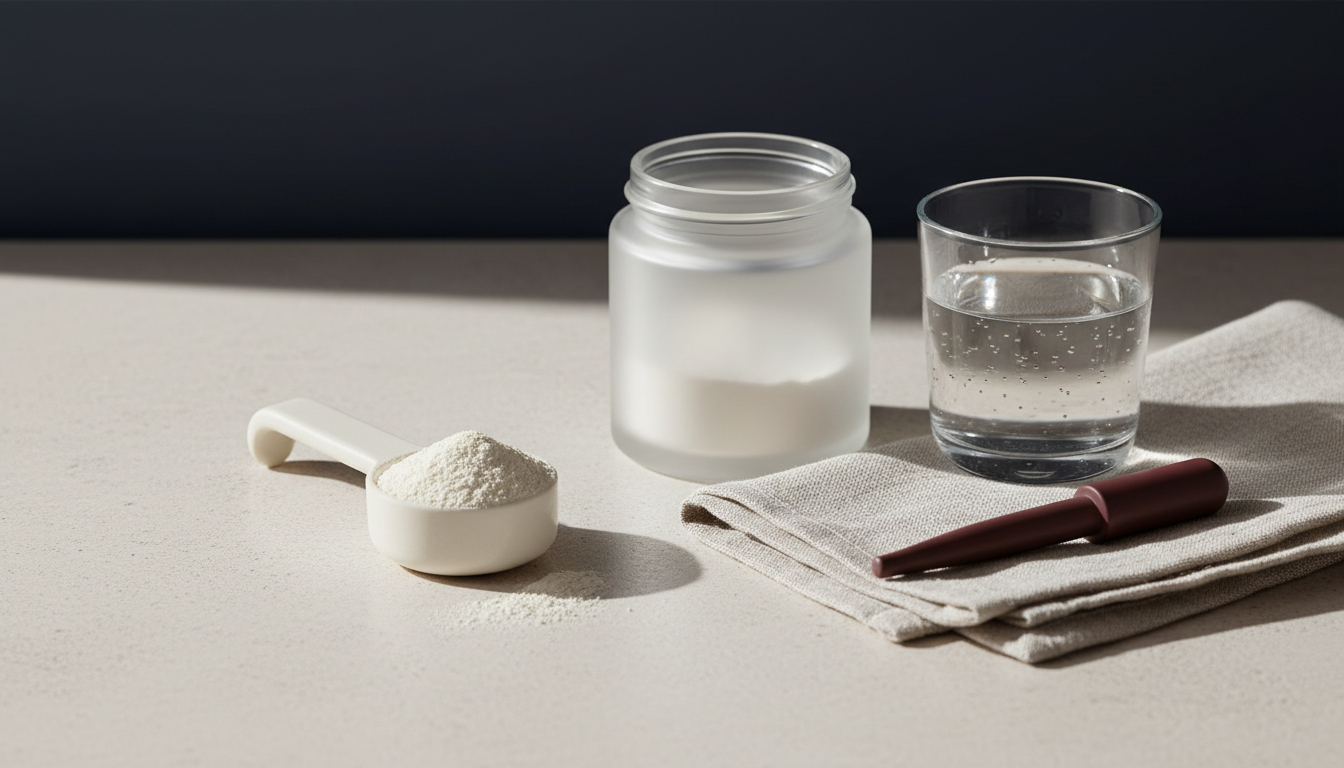
Bovine collagen is the most common source of hydrolyzed collagen peptides. What bovine collagen is, which skin and joint outcomes the human trials actually support, how it compares to marine collagen, and how to read a label, characterized against the evidence.
Mechanism explainers on PepVise aim for textbook-level clarity without the textbook's refusal to commit to a reading.
What readers ask us next.
- What is bovine collagen?
- Bovine collagen is collagen obtained from the hide, bone and connective tissue of cattle. For supplements it is almost always hydrolyzed, that is, broken into short collagen peptides that stir into cold liquid and are well absorbed. It is mostly type I and III collagen, the same types that dominate human skin, tendon and bone. This hydrolyzed bovine form is the one used in most human studies.
- Does bovine collagen work?
- For the outcomes studied there is moderate, consistent evidence. Randomized trials and a meta-analysis report small but measurable improvements in skin hydration and elasticity from hydrolyzed collagen, and separate trials show less activity-related joint pain. The preparations used were largely bovine or porcine. The key point is that the effects are modest and depend on a trial-relevant dose, not on the bovine source as such.
- Bovine collagen or marine collagen, which is better?
- For a drink, both are chemically very similar as hydrolyzed peptides, and no head-to-head trial shows a clear winner. Bovine collagen delivers type I and III and is usually much cheaper per gram. Marine collagen is mostly type I, has smaller peptides and suits people who avoid beef. Choose on price per gram, dietary preference and tolerance, not on a promise of a superior source.
- Is bovine collagen safe?
- For healthy adults, hydrolyzed collagen at the amounts studied is well tolerated; reported side effects are usually mild and gastrointestinal. Anyone with a beef allergy should avoid it. As with any supplement, purity and sourcing are a matter of the brand. Pregnant or breastfeeding people and those with existing conditions should clear it with a clinician. We characterize general collagen side effects separately.
- How much bovine collagen per day?
- The human trials used roughly 2.5 to 10 g of hydrolyzed collagen per day depending on the goal: nearer 2.5 to 5 g for skin endpoints and around 10 g in many joint and body studies. That range applies regardless of the bovine source. Work from grams per serving, not the front-of-pack claim. We put numbers on the daily amount in a dedicated piece.
References cited on this page.
PubMed, ClinicalTrials.gov, and FDA documents only. Secondary sources appear when needed to characterize public discourse, never as a source for a clinical claim.
- [01]Proksch E et al. Oral supplementation of specific collagen peptides has beneficial effects on human skin physiology. Skin Pharmacol Physiol 2014
- [02]de Miranda RB et al. Effects of hydrolyzed collagen supplementation on skin aging: a systematic review and meta-analysis. Int J Dermatol 2021
- [03]Clark KL et al. 24-week study on the use of collagen hydrolysate as a dietary supplement in athletes with activity-related joint pain. Curr Med Res Opin 2008
- [04]Iwai K et al. Identification of food-derived collagen peptides in human blood after oral ingestion of gelatin hydrolysates. J Agric Food Chem 2005
About The Pepvise Editorial Team
The Pepvise Editorial Team is a small group of researchers and science writers reading the peer-reviewed peptide literature and translating it into calm, cited analysis. We do not sell peptides, recommend peptides, or tell readers what to administer. We describe what has been measured, by whom, at what scale, with what effect size.
Compound reviews are signed off by Dr. Priya Narang, MD, MPH (endocrinologist) and Dr. Marcus Haley, PharmD, BCPS (board-certified clinical pharmacist). Both hold verifiable state-board licenses and have signed editorial-independence letters with us. See the full editorial board →
Adjacent in the literature.
Collagen Peptides vs Collagen: The Difference
Collagen peptides vs collagen on the evidence: why hydrolyzed peptides are absorbed while gelatin and whole collagen are not, which form the human trials actually used, and how undenatured type II fits.
9 min readConsumer · ExplainerHow to Boost Collagen Production Naturally
How to boost collagen production on the evidence: the vitamin C and protein your body needs to build it, the topical retinoids that raise it, and the sun, smoking and sugar that break it down.
9 min readConsumer · ComparisonThe 8 Best Collagen Peptides, Ranked
Eight collagen peptide powders compared on dose per serving, collagen type, third-party testing, and price per serving. Ranked from the ingredient panel and the published trials, before any link was attached.
13 min readGet the 2026 Peptide Evidence Ledger.
A 12-page PDF summary of where 10 major compounds sit, Preclinical / Human pilot / Phase trial / FDA status. Updated quarterly. Free.
By subscribing, you agree to our Privacy Policy. One calm, cited email a week. Unsubscribe anytime.