Collagen for bones, what the trials show
By The PepVise Editorial Team · Reviewed July 24, 2026 · 9 min read
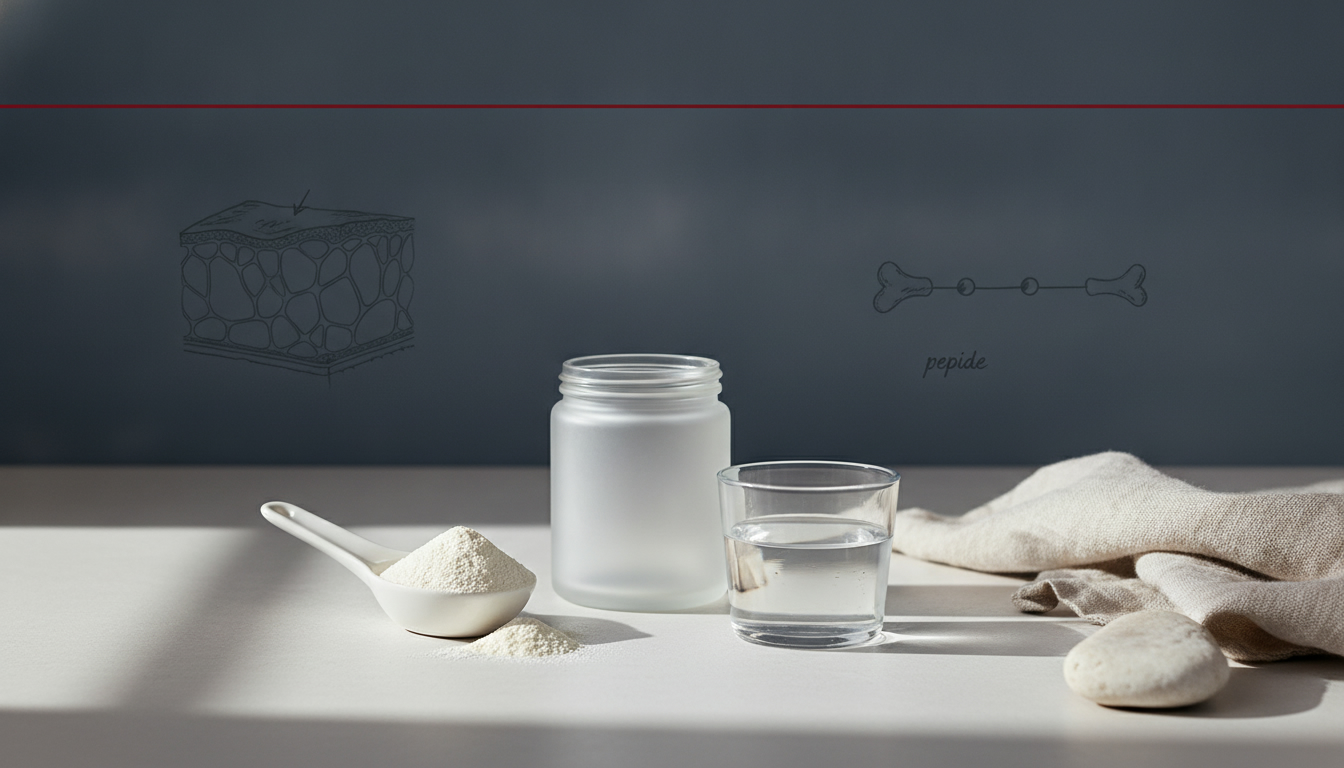
Collagen for bone health has one strong randomized trial behind it: 5 g of specific collagen peptides raised bone mineral density in postmenopausal women over a year. What the evidence shows, who it applies to, and where it does not replace osteoporosis treatment.
Mechanism explainers on PepVise aim for textbook-level clarity without the textbook's refusal to commit to a reading.
What readers ask us next.
- Does collagen improve bone density?
- In the population studied, yes, modestly. A 12-month randomized trial (König 2018) found 5 g of specific collagen peptides daily raised bone mineral density at the spine and femoral neck in postmenopausal women, with formation markers rising, and a 2025 meta-analysis confirmed a moderate effect, strongest alongside calcium and vitamin D. The evidence is concentrated in postmenopausal women with low bone density and does not automatically extend to everyone.
- How much collagen should I take for bones?
- The bone trials used about 5 g of specific collagen peptides daily, taken continuously for at least a year. That is the dose with evidence behind it. Bone remodels slowly, so shorter courses will not show a density change, and taking more than the studied dose has not been shown to add benefit.
- Can collagen reverse osteoporosis?
- No. Collagen is not a treatment for osteoporosis and not a substitute for medical care. Some trials show small density gains in postmenopausal women, but if you have diagnosed osteoporosis or high fracture risk, collagen is at most a minor adjunct to prescribed treatment, calcium, vitamin D, and exercise, decided with your doctor. It will not fix the disease on its own.
- How long does collagen take to work for bones?
- Far longer than for skin. The bone trials measured density at 12 months, and the four-year follow-up (Zdzieblik 2021) showed continued gains over time. Bone remodels on a months-to-years timescale, so a fair test is at least a year of daily use alongside calcium, vitamin D, and weight-bearing exercise, judged by a DEXA scan.
- Which collagen is best for bones?
- A clean hydrolyzed collagen peptide powder, third-party tested, delivering at least 5 g per serving is the rational choice, the same products that serve skin and joints. Pair it with adequate calcium, vitamin D, and weight-bearing exercise, which do more for bone than any supplement. We assess eight options in our best collagen peptides guide; the buying criteria are the same for bone.
References cited on this page.
PubMed, ClinicalTrials.gov, and FDA documents only. Secondary sources appear when needed to characterize public discourse, never as a source for a clinical claim.
- [01]König D et al. Specific Collagen Peptides Improve Bone Mineral Density and Bone Markers in Postmenopausal Women: A Randomized Controlled Study. Nutrients 2018
- [02]Zdzieblik D et al. Specific Bioactive Collagen Peptides in Osteopenia and Osteoporosis: Long-Term Observation in Postmenopausal Women. J Bone Metab 2021
- [03]Elam ML et al. A calcium-collagen chelate dietary supplement attenuates bone loss in postmenopausal women with osteopenia: a randomized controlled trial. J Med Food 2015
- [04]Sun C et al. Efficacy of collagen peptide supplementation on bone and muscle health: a meta-analysis. Front Nutr 2025
About The Pepvise Editorial Team
The Pepvise Editorial Team is a small group of researchers and science writers reading the peer-reviewed peptide literature and translating it into calm, cited analysis. We do not sell peptides, recommend peptides, or tell readers what to administer. We describe what has been measured, by whom, at what scale, with what effect size.
Compound reviews are signed off by Dr. Priya Narang, MD, MPH (endocrinologist) and Dr. Marcus Haley, PharmD, BCPS (board-certified clinical pharmacist). Both hold verifiable state-board licenses and have signed editorial-independence letters with us. See the full editorial board →
Adjacent in the literature.
Collagen Peptides vs Collagen: The Difference
Collagen peptides vs collagen on the evidence: why hydrolyzed peptides are absorbed while gelatin and whole collagen are not, which form the human trials actually used, and how undenatured type II fits.
9 min readConsumer · ExplainerHow to Boost Collagen Production Naturally
How to boost collagen production on the evidence: the vitamin C and protein your body needs to build it, the topical retinoids that raise it, and the sun, smoking and sugar that break it down.
9 min readConsumer · ComparisonThe 8 Best Collagen Peptides, Ranked
Eight collagen peptide powders compared on dose per serving, collagen type, third-party testing, and price per serving. Ranked from the ingredient panel and the published trials, before any link was attached.
13 min readGet the 2026 Peptide Evidence Ledger.
A 12-page PDF summary of where 10 major compounds sit, Preclinical / Human pilot / Phase trial / FDA status. Updated quarterly. Free.
By subscribing, you agree to our Privacy Policy. One calm, cited email a week. Unsubscribe anytime.