Collagen for osteoarthritis, what the evidence supports
By The PepVise Editorial Team · Reviewed July 27, 2026 · 9 min read
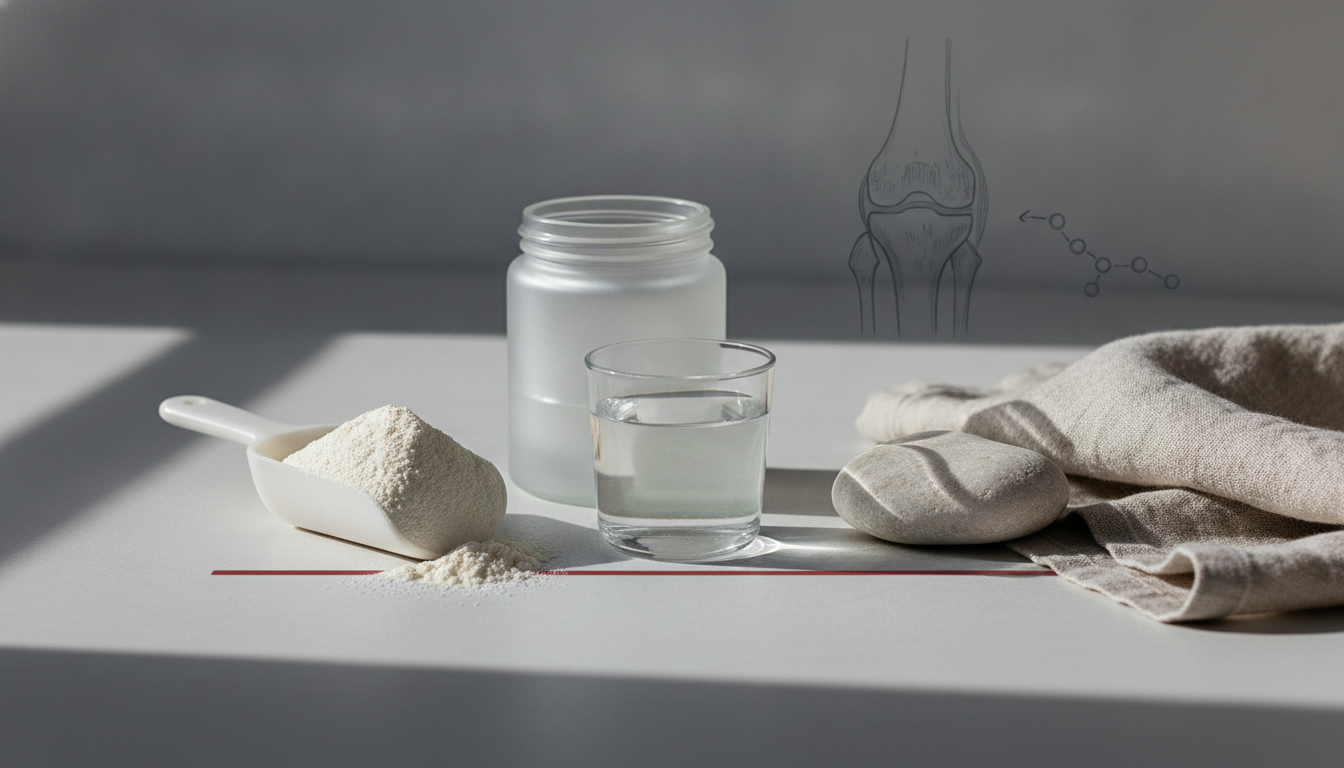
Osteoarthritis breaks down cartilage, and collagen is that cartilage's main building block, so the question is fair. What the randomized trials show for hydrolyzed collagen and for undenatured type II collagen in knee osteoarthritis, whether cartilage itself changes, and where collagen sits alongside real OA care.
Mechanism explainers on PepVise aim for textbook-level clarity without the textbook's refusal to commit to a reading.
What readers ask us next.
- Does collagen help with osteoarthritis?
- Modestly, and in some people, yes. Randomized trials of hydrolyzed collagen (Benito-Ruiz 2009, Park 2025) and of undenatured type II collagen (Lugo 2016) found improvements in pain and function in knee osteoarthritis versus placebo. The effects are modest and appear over months. Collagen does not cure osteoarthritis and does not replace exercise, weight management, and the treatment discussed with your clinician.
- Which collagen is better for osteoarthritis, hydrolyzed or undenatured type II?
- They are two different approaches, each with its own evidence. Hydrolyzed collagen (around 10 g a day) is meant to act as a building block; undenatured type II collagen (UC-II, about 40 mg a day) is meant to work through the gut immune system to calm the inflammatory response against cartilage. Both have shown improvement in trials. A head-to-head comparison across many large trials is missing, so it cannot be stated definitively which is superior.
- Does collagen rebuild cartilage in osteoarthritis?
- That is not established. Most of the positive results are for pain and function, not a demonstrated rebuilding of cartilage. A small early MRI study (McAlindon 2011) found signs of a possible increase in cartilage content, but that is not enough to prove structural remodeling of the joint. View collagen as a possible symptom benefit, not a cartilage-building agent.
- How much collagen was used in the osteoarthritis trials?
- For hydrolyzed collagen, the trials mostly used around 10 g a day for at least three to six months. For undenatured type II collagen (UC-II), it was about 40 mg a day over 180 days. In both cases it is a sustained habit rather than a short trial, and any benefit shows up over months. This reports trial doses and is not a personal dosing recommendation.
- Can collagen replace my osteoarthritis medication?
- No. Collagen is at most a complementary support with modest evidence, not an osteoarthritis treatment. Do not change or stop prescribed medication without talking to your clinician. The foundations of OA care remain exercise and strength work, weight management, and the options discussed with your doctor.
References cited on this page.
PubMed, ClinicalTrials.gov, and FDA documents only. Secondary sources appear when needed to characterize public discourse, never as a source for a clinical claim.
- [01]Lugo JP et al. Efficacy and tolerability of an undenatured type II collagen supplement in modulating knee osteoarthritis symptoms: a multicenter randomized, double-blind, placebo-controlled study. Nutr J 2016
- [02]Benito-Ruiz P et al. A randomized controlled trial on the efficacy and safety of a food ingredient, collagen hydrolysate, for improving joint comfort. Int J Food Sci Nutr 2009
- [03]Park SY et al. Efficacy and safety of low-molecular-weight collagen peptides in knee osteoarthritis: a randomized, double-blind, placebo-controlled trial. Front Nutr 2025
- [04]McAlindon TE et al. Change in knee osteoarthritis cartilage detected by delayed gadolinium enhanced magnetic resonance imaging following treatment with collagen hydrolysate. Osteoarthritis Cartilage 2011
About The Pepvise Editorial Team
The Pepvise Editorial Team is a small group of researchers and science writers reading the peer-reviewed peptide literature and translating it into calm, cited analysis. We do not sell peptides, recommend peptides, or tell readers what to administer. We describe what has been measured, by whom, at what scale, with what effect size.
Compound reviews are signed off by Dr. Priya Narang, MD, MPH (endocrinologist) and Dr. Marcus Haley, PharmD, BCPS (board-certified clinical pharmacist). Both hold verifiable state-board licenses and have signed editorial-independence letters with us. See the full editorial board →
Adjacent in the literature.
Collagen Peptides vs Collagen: The Difference
Collagen peptides vs collagen on the evidence: why hydrolyzed peptides are absorbed while gelatin and whole collagen are not, which form the human trials actually used, and how undenatured type II fits.
9 min readConsumer · ExplainerHow to Boost Collagen Production Naturally
How to boost collagen production on the evidence: the vitamin C and protein your body needs to build it, the topical retinoids that raise it, and the sun, smoking and sugar that break it down.
9 min readConsumer · ComparisonThe 8 Best Collagen Peptides, Ranked
Eight collagen peptide powders compared on dose per serving, collagen type, third-party testing, and price per serving. Ranked from the ingredient panel and the published trials, before any link was attached.
13 min readGet the 2026 Peptide Evidence Ledger.
A 12-page PDF summary of where 10 major compounds sit, Preclinical / Human pilot / Phase trial / FDA status. Updated quarterly. Free.
By subscribing, you agree to our Privacy Policy. One calm, cited email a week. Unsubscribe anytime.