Collagen in coffee, does the heat wreck it
By The PepVise Editorial Team · Reviewed July 13, 2026 · 7 min read
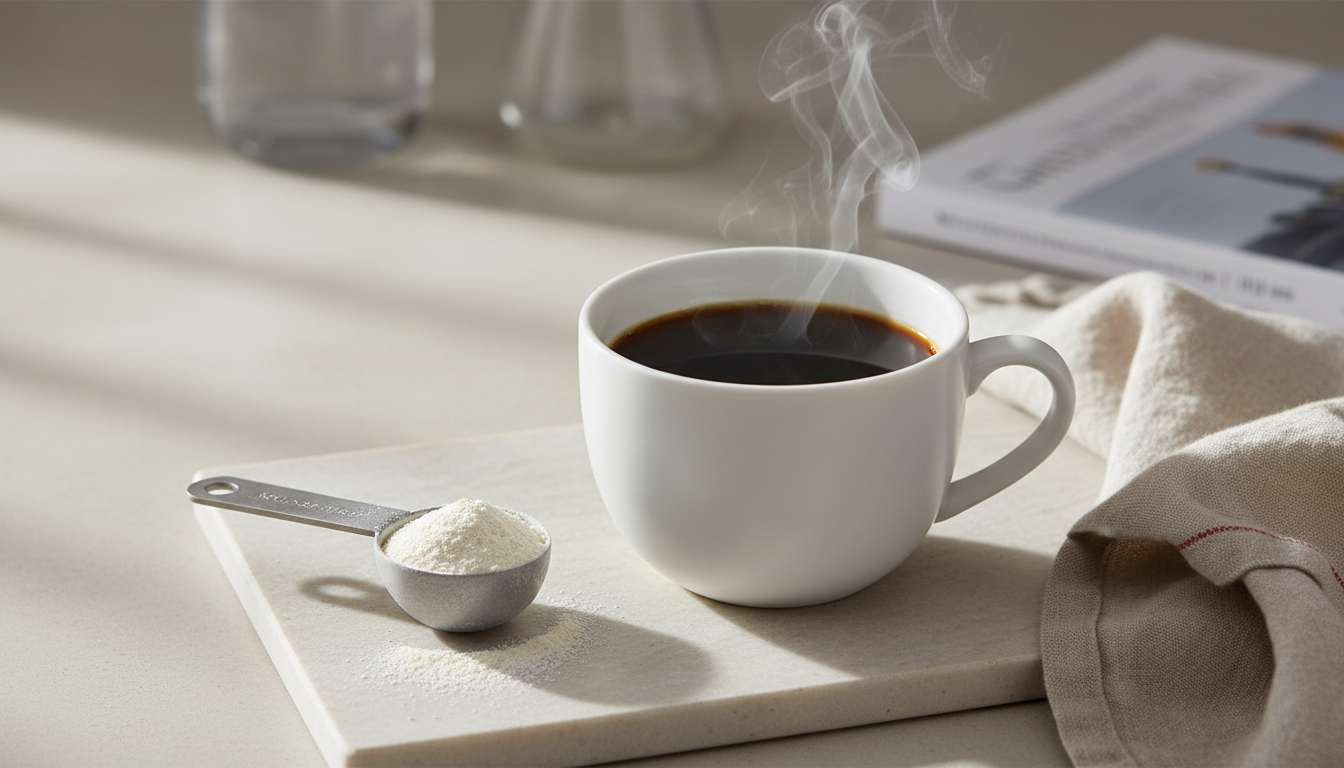
Does hot coffee destroy collagen? Why the 'heat denatures it' worry misreads the chemistry of hydrolyzed collagen, what actually happens when you stir it into a hot cup, and how to do it well.
Mechanism explainers on PepVise aim for textbook-level clarity without the textbook's refusal to commit to a reading.
What readers ask us next.
- Does hot coffee destroy collagen?
- No. Supplement collagen is hydrolyzed, meaning it is already broken into short peptides and free amino acids, so there is no folded structure for heat to unwind. Amino acids are heat-stable at the temperature of a cup of coffee, and there is no evidence that stirring collagen into a hot drink removes its benefit.
- Can you put collagen in coffee?
- Yes. Stir unflavored hydrolyzed collagen powder into the finished cup and it dissolves clear and nearly tasteless. Add it after brewing rather than boiling it with the grounds, and give it a good stir so it does not clump.
- Does collagen lose its effectiveness in coffee?
- There is no good evidence that it does. The trials that measured skin and joint effects used ingested hydrolyzed collagen, and the peptides are absorbed regardless of the vehicle. Normal coffee temperatures do not meaningfully degrade the amino acid content over the few minutes a drink lasts.
- How much collagen should I put in coffee?
- Study doses run from about 2.5 to 15 g per day, and many skin and joint trials used roughly 10 g. Start within that range, take it consistently, and split it across two drinks if a single scoop feels heavy on your stomach.
- Does caffeine block collagen absorption?
- There is no evidence that it does. Collagen is digested as a protein, broken into amino acids and small peptides that are absorbed normally, and coffee does not switch that process off. The dose and consistency matter far more than whether you take it with caffeine.
References cited on this page.
PubMed, ClinicalTrials.gov, and FDA documents only. Secondary sources appear when needed to characterize public discourse, never as a source for a clinical claim.
- [01]de Miranda RB et al. Effects of hydrolyzed collagen supplementation on skin aging: a systematic review and meta-analysis. Int J Dermatol 2021
- [02]Iwai K et al. Identification of food-derived collagen peptides in human blood after oral ingestion of gelatin hydrolysates. J Agric Food Chem 2005
- [03]Paul C et al. Significant amounts of functional collagen peptides can be incorporated in the diet. Nutrients 2019
About The Pepvise Editorial Team
The Pepvise Editorial Team is a small group of researchers and science writers reading the peer-reviewed peptide literature and translating it into calm, cited analysis. We do not sell peptides, recommend peptides, or tell readers what to administer. We describe what has been measured, by whom, at what scale, with what effect size.
Compound reviews are signed off by Dr. Priya Narang, MD, MPH (endocrinologist) and Dr. Marcus Haley, PharmD, BCPS (board-certified clinical pharmacist). Both hold verifiable state-board licenses and have signed editorial-independence letters with us. See the full editorial board →
Adjacent in the literature.
Collagen Peptides vs Collagen: The Difference
Collagen peptides vs collagen on the evidence: why hydrolyzed peptides are absorbed while gelatin and whole collagen are not, which form the human trials actually used, and how undenatured type II fits.
9 min readConsumer · ExplainerHow to Boost Collagen Production Naturally
How to boost collagen production on the evidence: the vitamin C and protein your body needs to build it, the topical retinoids that raise it, and the sun, smoking and sugar that break it down.
9 min readConsumer · ComparisonThe 8 Best Collagen Peptides, Ranked
Eight collagen peptide powders compared on dose per serving, collagen type, third-party testing, and price per serving. Ranked from the ingredient panel and the published trials, before any link was attached.
13 min readGet the 2026 Peptide Evidence Ledger.
A 12-page PDF summary of where 10 major compounds sit, Preclinical / Human pilot / Phase trial / FDA status. Updated quarterly. Free.
By subscribing, you agree to our Privacy Policy. One calm, cited email a week. Unsubscribe anytime.