Collagen versus whey, which protein does which job
Collagen vs whey compared on the evidence: why whey builds muscle and collagen does not, what collagen does that whey cannot, and when to use each or both.
By The PepVise Editorial Team · Reviewed July 19, 2026 · 9 min read
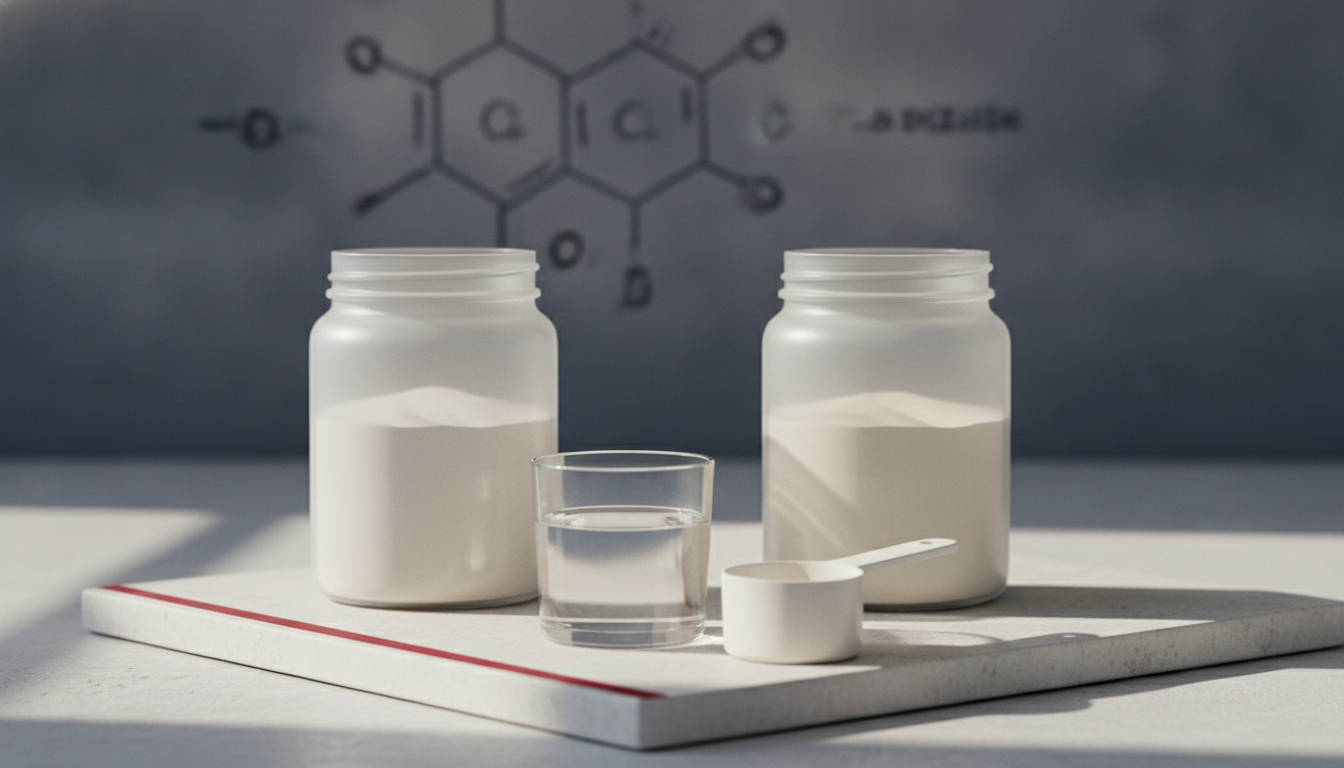
Side-by-side comparisons on PepVise rank by weight of evidence, not by bodybuilding forum consensus. Tier badges on every entry.
How we read the literature
- Evidence tier
- We grade the literature on four tiers, High (replicated RCTs or meta-analyses), Moderate (multiple trials with mixed findings), Low (a single pilot or case series), and Anecdotal (preclinical only, no human data). The tier appears on every compound profile beside the claim it supports.
- Trial stage
- Where a compound sits in the human development pipeline is recorded as Preclinical, Phase 1, Phase 2, or Phase 3+. We pull the current stage from ClinicalTrials.gov and the EU Clinical Trials Register on access date and re-verify quarterly.
- Regulatory status
- We state the FDA posture plainly, approved for indication X, or labeled for research use only, or removed from the 503A list, or investigational under a specific IND. Regulatory status changes; every post carries a review date.
- Where we're uncertain
- Every compound profile closes with a named uncertainty section, the question we can't answer from the current literature, the trial we'd want to see, the effect size we'd treat as a real signal. Uncertainty is not a failure mode here; it's load-bearing.
What readers ask us next.
- Is collagen or whey better for building muscle?
- Whey, clearly. Whey is a complete protein high in leucine, the amino acid that drives muscle protein synthesis, while collagen is incomplete and very low in leucine with no tryptophan. Oikawa 2020 compared them directly and found whey stimulated muscle protein synthesis while collagen did not. For muscle, whey or another complete protein is the evidence-based choice.
- Can collagen replace whey protein?
- Not for muscle or as your main protein. Collagen is a low-quality protein for muscle because it lacks tryptophan and is very low in leucine and branched-chain amino acids, so it cannot do whey's job of feeding muscle synthesis. It can complement whey for skin and joint goals, but it is not a substitute for a complete protein.
- Does collagen count toward my daily protein target?
- Only loosely. Collagen contributes grams of protein, but because it is incomplete and missing tryptophan, it is poor-quality protein for muscle and should not be counted as a large part of your target. Use a complete protein such as whey for the bulk of your intake and treat collagen as an add-on for its specific skin and joint evidence.
- Can I take collagen and whey together?
- Yes, and it often makes sense because they do different jobs. Whey supports muscle and your daily protein target, collagen has the trial evidence for skin and joints, and there is no known interference between them. Many people use whey toward their protein goal and a separate collagen dose of roughly 2.5 to 15 grams for skin or connective-tissue support.
- Is collagen better than whey for skin?
- Yes, on the evidence. Specific collagen peptides have controlled human trials linking them to modest gains in skin hydration and elasticity (Proksch 2014), whereas whey has no comparable skin evidence. Skin and connective tissue are collagen's evidence area, just as muscle is whey's.
A new Phase 2 trial for any of the ranked compounds. A regulatory action changing FDA status. A published replication failure in an independent lab. Any of those would move entries on this list within a week, with a dated note on what changed.
References cited on this page.
PubMed, ClinicalTrials.gov, and FDA documents only. Secondary sources appear when needed to characterize public discourse, never as a source for a clinical claim.
- [01]Oikawa SY et al. Whey protein but not collagen peptides stimulate acute and longer-term muscle protein synthesis with and without resistance exercise in healthy older women. Am J Clin Nutr 2020
- [02]Zdzieblik D et al. Collagen peptide supplementation in combination with resistance training improves body composition and increases muscle strength in elderly sarcopenic men. Br J Nutr 2015
- [03]Proksch E et al. Oral supplementation of specific collagen peptides has beneficial effects on human skin physiology. Skin Pharmacol Physiol 2014
- [04]Clark KL et al. 24-week study on the use of collagen hydrolysate in athletes with activity-related joint pain. Curr Med Res Opin 2008
About The Pepvise Editorial Team
The Pepvise Editorial Team is a small group of researchers and science writers reading the peer-reviewed peptide literature and translating it into calm, cited analysis. We do not sell peptides, recommend peptides, or tell readers what to administer. We describe what has been measured, by whom, at what scale, with what effect size.
Compound reviews are signed off by Dr. Priya Narang, MD, MPH (endocrinologist) and Dr. Marcus Haley, PharmD, BCPS (board-certified clinical pharmacist). Both hold verifiable state-board licenses and have signed editorial-independence letters with us. See the full editorial board →
Adjacent in the literature.
Collagen Peptides vs Collagen: The Difference
Collagen peptides vs collagen on the evidence: why hydrolyzed peptides are absorbed while gelatin and whole collagen are not, which form the human trials actually used, and how undenatured type II fits.
9 min readConsumer · ExplainerHow to Boost Collagen Production Naturally
How to boost collagen production on the evidence: the vitamin C and protein your body needs to build it, the topical retinoids that raise it, and the sun, smoking and sugar that break it down.
9 min readConsumer · ComparisonThe 8 Best Collagen Peptides, Ranked
Eight collagen peptide powders compared on dose per serving, collagen type, third-party testing, and price per serving. Ranked from the ingredient panel and the published trials, before any link was attached.
13 min readGet the 2026 Peptide Evidence Ledger.
A 12-page PDF summary of where 10 major compounds sit, Preclinical / Human pilot / Phase trial / FDA status. Updated quarterly. Free.
By subscribing, you agree to our Privacy Policy. One calm, cited email a week. Unsubscribe anytime.