Kollagenpeptide gegenüber Kollagen, was wirklich anders ist
Kollagenpeptide oder Kollagen an der Evidenz: warum hydrolysierte Peptide aufgenommen werden, Gelatine und ganzes Kollagen aber nicht, welche Form die Studien nutzten und wo natives Typ-II-Kollagen steht.
By The PepVise Editorial Team · Reviewed July 22, 2026 · 9 min read
Side-by-side comparisons on PepVise rank by weight of evidence, not by bodybuilding forum consensus. Tier badges on every entry.
How we read the literature
- Evidence tier
- We grade the literature on four tiers, High (replicated RCTs or meta-analyses), Moderate (multiple trials with mixed findings), Low (a single pilot or case series), and Anecdotal (preclinical only, no human data). The tier appears on every compound profile beside the claim it supports.
- Trial stage
- Where a compound sits in the human development pipeline is recorded as Preclinical, Phase 1, Phase 2, or Phase 3+. We pull the current stage from ClinicalTrials.gov and the EU Clinical Trials Register on access date and re-verify quarterly.
- Regulatory status
- We state the FDA posture plainly, approved for indication X, or labeled for research use only, or removed from the 503A list, or investigational under a specific IND. Regulatory status changes; every post carries a review date.
- Where we're uncertain
- Every compound profile closes with a named uncertainty section, the question we can't answer from the current literature, the trial we'd want to see, the effect size we'd treat as a real signal. Uncertainty is not a failure mode here; it's load-bearing.
What readers ask us next.
- Sind Kollagenpeptide und Kollagen dasselbe?
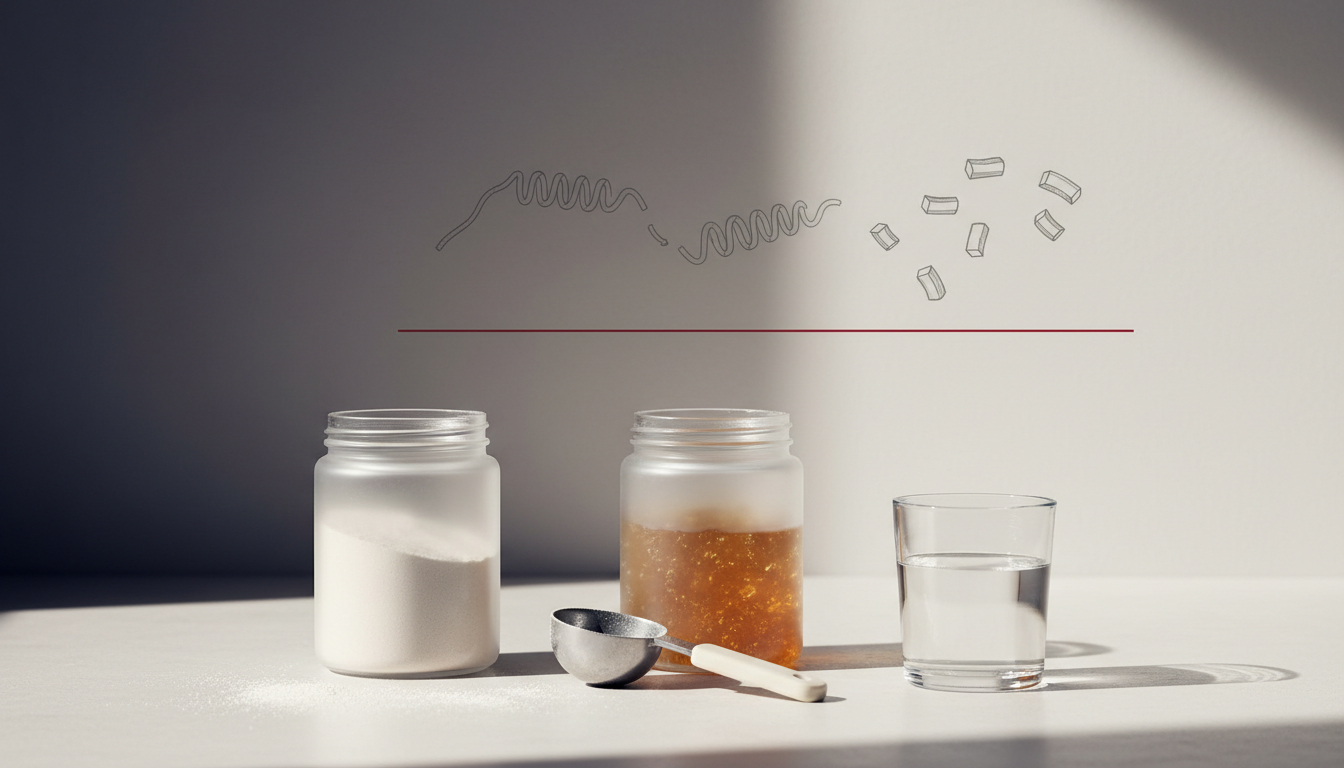
- Es ist dasselbe Protein in verschiedenen Verarbeitungsstufen. Kollagenpeptide, auch hydrolysiertes Kollagen genannt, sind Kollagen, das enzymatisch in kurze, aufnehmbare Fragmente geschnitten wurde. Reines Kollagen und Gelatine sind dasselbe Molekül vor diesem Schnitt. Entscheidend ist die Fragmentgröße, denn nur die kleinen hydrolysierten Peptide werden in nennenswerter Menge aufgenommen und im Blut nachgewiesen.
- Was ist besser, Kollagenpeptide oder gewöhnliches Kollagen?
- Für Haut- und allgemeine Gelenkziele sind hydrolysierte Kollagenpeptide die besser belegte Wahl, weil nahezu jede Studie mit berichtetem Nutzen die Peptidform verwendete und weil Peptide aufgenommen werden, während ganzes Kollagen und Gelatine wie gewöhnliches Protein verdaut werden. Die Ausnahme ist natives Typ-II-Kollagen, ein getrenntes, niedrig dosiertes Produkt, das speziell für Gelenkbeschwerden über einen anderen Mechanismus untersucht wurde.
- Ist Gelatine so gut wie Kollagenpeptide?
- Gelatine ist dasselbe Protein und liefert dieselben Aminosäuren, aber sie ist nicht die in den Studien verwendete Form und wird nicht als intakte, kollagenspezifische Peptide aufgenommen. Sie geliert zudem und löst sich nicht sauber in einem kalten Getränk. Als Lebensmittel ist sie in Ordnung; als Ersatz für die erforschte Peptiddosis ist sie nicht gleichwertig.
- Was ist natives Typ-II-Kollagen und wie unterscheidet es sich?
- Natives Typ-II-Kollagen, oft als UC-II ausgewiesen, ist intaktes Kollagen, das in winzigen Milligrammdosen statt in Gramm eingenommen wird. Statt Bausteine zu liefern, ist sein vermuteter Mechanismus ein immuntoleranter Effekt im Gelenk. Es wurde bei Kniearthrose von Crowley 2009 und Lugo 2016 untersucht und ist nicht mit den hydrolysierten Pulvern im Grammbereich für Haut und allgemeine Gelenkunterstützung austauschbar.
- Ändert marine oder Rinderkollagen, ob es Peptide sind?
- Nein. Marine und Rind beschreiben die Tierquelle, Fischhaut oder Rinderhaut, nicht die Verarbeitung. Beide werden meist als hydrolysierte Kollagenpeptide verkauft. Die Quelle beeinflusst Aminosäureprofil und Preis leicht, aber ob ein Produkt die aufnehmbare Peptidform ist, hängt vom Wort hydrolysiert ab, nicht vom Tier.
A new Phase 2 trial for any of the ranked compounds. A regulatory action changing FDA status. A published replication failure in an independent lab. Any of those would move entries on this list within a week, with a dated note on what changed.
References cited on this page.
PubMed, ClinicalTrials.gov, and FDA documents only. Secondary sources appear when needed to characterize public discourse, never as a source for a clinical claim.
- [01]Iwai K et al. Identification of food-derived collagen peptides in human blood after oral ingestion of gelatin hydrolysates. J Agric Food Chem 2005
- [02]Proksch E et al. Oral supplementation of specific collagen peptides has beneficial effects on human skin physiology. Skin Pharmacol Physiol 2014
- [03]Clark KL et al. 24-week study on the use of collagen hydrolysate in athletes with activity-related joint pain. Curr Med Res Opin 2008
- [04]Crowley DC et al. Safety and efficacy of undenatured type II collagen in the treatment of osteoarthritis of the knee: a clinical trial. Int J Med Sci 2009
- [05]Lugo JP et al. Efficacy and tolerability of an undenatured type II collagen supplement in modulating knee osteoarthritis symptoms: a multicenter randomized, double-blind, placebo-controlled study. Nutr J 2016
- [06]Bello AE, Oesser S. Collagen hydrolysate for the treatment of osteoarthritis and other joint disorders: a review of the literature. Curr Med Res Opin 2006
About The Pepvise Editorial Team
The Pepvise Editorial Team is a small group of researchers and science writers reading the peer-reviewed peptide literature and translating it into calm, cited analysis. We do not sell peptides, recommend peptides, or tell readers what to administer. We describe what has been measured, by whom, at what scale, with what effect size.
Compound reviews are signed off by Dr. Priya Narang, MD, MPH (endocrinologist) and Dr. Marcus Haley, PharmD, BCPS (board-certified clinical pharmacist). Both hold verifiable state-board licenses and have signed editorial-independence letters with us. See the full editorial board →
Adjacent in the literature.
How to Boost Collagen Production Naturally
How to boost collagen production on the evidence: the vitamin C and protein your body needs to build it, the topical retinoids that raise it, and the sun, smoking and sugar that break it down.
9 min readConsumer · ComparisonThe 8 Best Collagen Peptides, Ranked
Eight collagen peptide powders compared on dose per serving, collagen type, third-party testing, and price per serving. Ranked from the ingredient panel and the published trials, before any link was attached.
13 min readConsumer · ComparisonThe 8 Best Peptide Serums, Ranked
Eight peptide serums and creams compared on which peptides they actually contain, what published evidence sits behind each one, and what you pay per millilitre. Ranked from the INCI list, not the marketing.
13 min readGet the 2026 Peptide Evidence Ledger.
A 12-page PDF summary of where 10 major compounds sit, Preclinical / Human pilot / Phase trial / FDA status. Updated quarterly. Free.
By subscribing, you agree to our Privacy Policy. One calm, cited email a week. Unsubscribe anytime.